
- Camera Diagnosed · Trenchless When Possible
Sewer Line Repair Arlington Heights | From Camera Diagnosis to Permit Closeout
A failing sewer lateral is one of the most expensive surprises a homeowner can face, and the wrong contractor can turn a 4,000 dollar trenchless lining into a 14,000 dollar full excavation almost overnight.
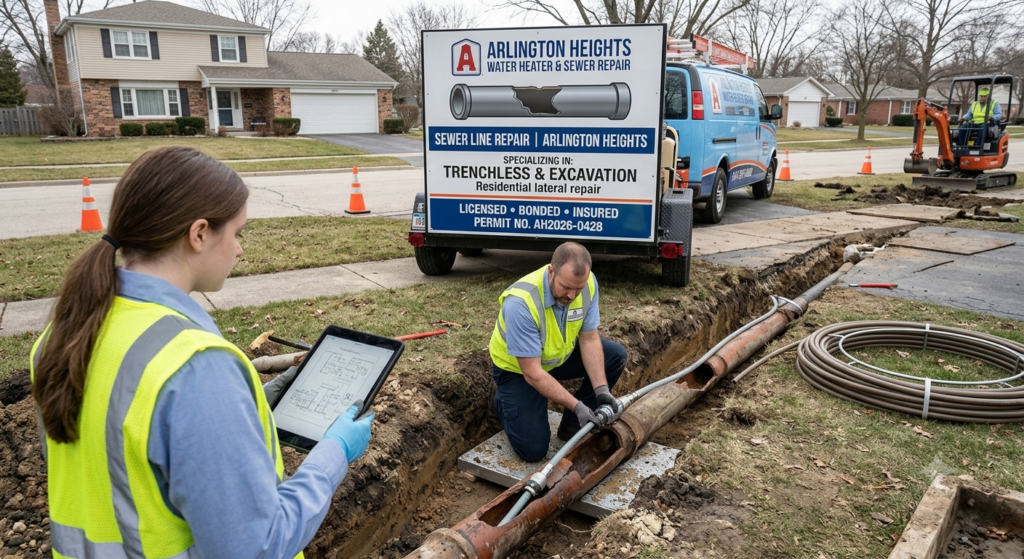
Our crew starts every job with a camera inspection so you see the actual problem yourself, then recommends the least invasive method that will actually solve it, pulls the village permit, and stands behind the work.
Camera
Diagnosis Before Any Quote
Trenchless
When the Pipe Allows
Village
Permits Pulled and Closed
- See it yourself
Local crew, local code
Cook County and Village of Arlington Heights specs
- The Quick Answer
Honest sewer line repair Arlington Heights homeowners can rely on a process that always starts with a camera inspection so the cause and exact location of the failure are known before any quote is given. From there, the right method depends on the pipe itself.
A cracked but round clay tile lateral is usually a candidate for cured-in-place pipe lining at roughly 80 to 200 dollars per foot. A collapsed or Orangeburg line needs pipe bursting or full excavation. The honest contractor will show you the camera footage, explain the math, and recommend the least invasive method that will actually last.
Six Warning Signs Your Sewer Line Is Failing
Sewer lines rarely fail without warning. The signs below are how your underground lateral tells you it is in trouble. Catching the problem before sewage backs up into the basement is the difference between a planned, smaller repair and an emergency that includes restoration of finished space.
Multiple Drains Slow at the Same Time
One slow sink is a local clog. A toilet that gurgles when the laundry empties, plus a slow shower, plus a slow tub, means the restriction is in the main lateral that runs from the house to the street, not in any individual fixture.
Recurring Backups Through Floor Drains
If you have rodded the same main line two or three times in a year, the problem is structural, not a one off clog. Roots, an offset joint, a belly in the line, or a partial collapse are pulling debris back into the same spot every time.
Sewage Odors Inside or in the Yard
A sour smell rising from a basement floor drain, the laundry standpipe, or a patch of lawn between the house and the street usually means raw sewage is escaping a cracked lateral underground. This is both a property and a health hazard.
Unexplained Wet Patches in the Lawn
Lush, suspiciously green grass over the line, or wet spongy ground after a dry week, suggests the lateral is leaking effluent into the soil. In Cook County clay this water has nowhere to go and pools above the failure point.
Foundation Cracks or Settling
A long term lateral leak washes soil out from under the foundation and slab. New hairline cracks in basement walls, sloping floors near drain stacks, or a sinking section of driveway over the line all warrant a camera inspection of the sewer underneath.
Pest Activity Around the Drains
Rats, sewer flies, and roaches getting into a home from below almost always come through a cracked lateral or a failed cleanout connection. A camera inspection finds the access point that no amount of bait or trap will close.
The Lateral Is Your Responsibility, From the House All the Way to the Village Main
This catches a lot of homeowners off guard. The Village of Arlington Heights considers every resident homeowner responsible for the entire sanitary service line, including the connection to the Village's main sewer under the street. If a root cracks the line two feet inside your property line or twenty feet past the curb, the repair is still on you.
If sewage is actively backing up into your home right now, the Village asks you to call the Public Works Department before calling a plumber so they can rule out a problem on the municipal main first.
Village Public Works · 847-368-5800
What Your Lateral Is Made of, By the Year Your Home Was Built
The age of your home tells us almost everything about the underground material we will find on the camera. Each material has predictable failure patterns, an expected lifespan, and a sensible leak repair approach. Here is the timeline for most Arlington Heights homes.
Pre 1970
Vitreous Clay Tile (Terracotta)
The standard residential lateral material across Cook County until the mid 1970s. The pipe itself is strong, but it comes in short two foot sections with mortar joints every couple of feet. Tree roots find those joints, work their way in, and over decades pry the line apart. The most common Arlington Heights repair scenario by far.
1950s to 1970s
Orangeburg (Tar Paper Pipe)
A fibrous composite of wood pulp and pitch installed as a budget alternative through the mid century. It deforms and collapses under soil pressure and is essentially unrepairable. If a camera finds Orangeburg in your line, replacement is the only honest answer. Pipe bursting is the standard approach.
1970s to 1980s
Cast Iron Inside, Clay or Early PVC Underground
Interior drain stacks in this era were typically cast iron, which corrodes and scales from the inside over time. Outside the foundation, you may find clay tile or early generation PVC. Cast iron is a candidate for lining if the pipe is still round and intact.
Post 1985
Schedule 40 PVC
Modern PVC with solvent welded joints is the gold standard. Smooth interior, corrosion resistant, and not vulnerable to root intrusion the way clay is. Most failures on PVC lines are due to ground settlement causing a sag or belly, rather than the pipe itself giving out.
How Sewer Lines Actually Get Repaired
Not every line needs trenchless repair, and not every line can be saved with a lining. The camera tells us which of the three approaches below makes sense for your specific situation.
Method 01
Cured in Place Pipe Lining
An epoxy saturated felt liner is pulled through the existing line from a single access point, inflated against the inner pipe wall, and cured in place to form a smooth, seamless new pipe inside the old one. No trench, no torn up landscaping, no broken driveway.
- Seamless and root resistant
- Minimal yard disruption
- 50 plus year warranty typical
Best for: a cracked but still round clay tile or cast iron lateral with no major sags or collapse points.
Method 02
Pipe Bursting
Two small access pits are dug, one at each end of the run. A hydraulic head is pulled through the old pipe, fracturing it outward into the surrounding soil while simultaneously dragging a new high density polyethylene pipe into place behind it. Trenchless, but heavier duty than lining.
- Replaces collapsed Orangeburg
- Brand new HDPE pipe
- 100 year material lifespan
Best for: collapsed Orangeburg, severely offset joints, or any line that has lost its round shape and cannot accept a liner.
Method 02
Traditional Excavation
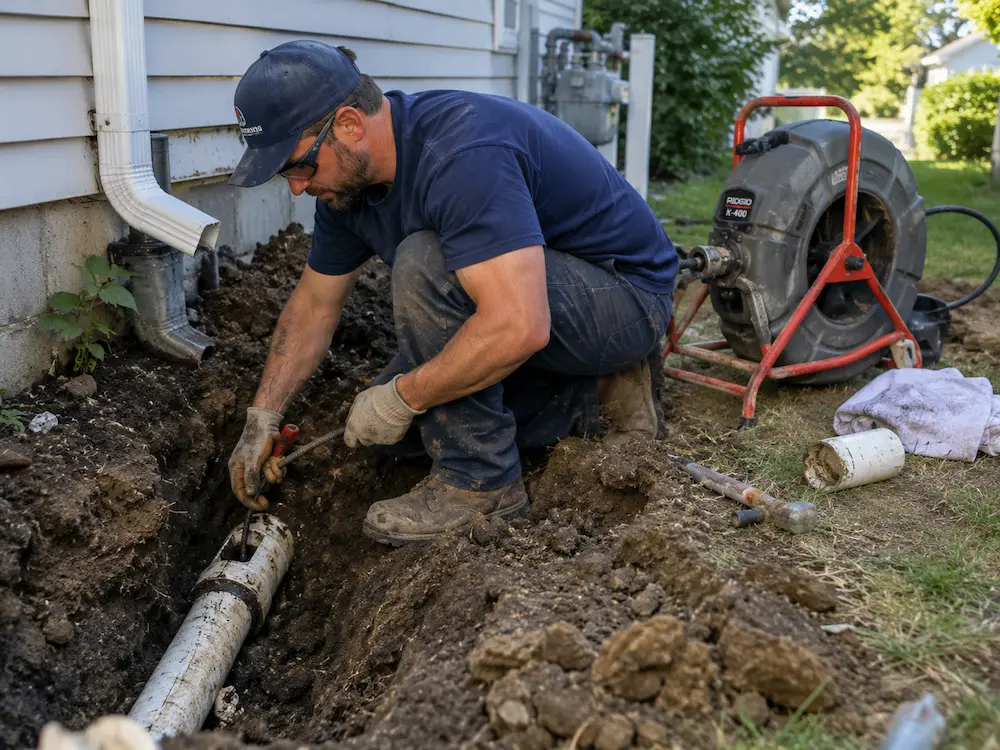
A trench is dug along the length of the failed line, the old pipe is removed, and new Schedule 40 PVC is laid, sloped, and connected. Higher restoration cost because of the trench, but sometimes the only sensible answer when access from the surface is the cleanest path.
- Full visual inspection of the run
- New cleanout installs are easy
- Necessary near the foundation
Best for: short failure sections, deep collapses, lines under landscaping that is already due for replacement, and connection point work near the foundation.
Why a Truly Local Crew Saves Real Money on Sewer Work
Sewer work is the one plumbing job where local knowledge beats national branding by the widest margin.
A crew that has opened the ground in Scarsdale, Hasbrook, Ivy Hill, Pioneer Park, and Stonegate already knows what they will find. Clay tile from the 1950s and 1960s in older sections, mature parkway elms and silver maples sending roots into every joint, glacial clay soil that holds water against the pipe, and shallow burial depths that simplify trenchless access.
The sewer line repair Arlington Heights homeowners need is one that accounts for those specific conditions and follows the permitting process correctly through the Village rather than skipping it and leaving you with a closure problem when you sell the home years later.
- Licensed by Illinois Department of Public Health
- Trenchless certified for CIPP and pipe bursting
- Village of Arlington Heights permit pulled on every job
- A local team, never a routing service
The Village of Arlington Heights Sewer Backup Rebate Program
A lot of homeowners do not realize this exists. The Village of Arlington Heights runs a long standing rebate program for residents who install qualifying flood control and overhead sewer conversion systems and drain cleaning systems on their property.
The enhanced program covers up to 75 percent of direct conversion costs, capped at 11,250 dollars per home, with permit fees waived for qualifying work. We will tell you up front whether your situation qualifies and walk you through the application.
75%
Of Direct Conversion Costs
$11,250
Maximum Rebate Per Home
$0
Permit Fees on Qualifying Work
What Drain Cleaning Typically Costs Here
- These are honest typical ranges for the Arlington Heights area. Final pricing depends on access, the cleanout location, and the condition of your line, and you always get an exact quote in writing before any work begins.
-
Sewer Camera Inspection $225 to $385
With recording on USB
-
Sewer Locating and Marking $185 to $325
For trenchless planning
-
Spot Repair, Single Section $1,800 to $3,800
Excavation, simple access
-
Cured in Place Pipe Lining $80 to $200
Per linear foot
-
Pipe Bursting Replacement $100 to $200
Per linear foot, with new HDPE
-
Traditional Excavation and Replacement $125 to $275
Per linear foot, with restoration
-
Typical Full Lateral Lining $4,000 to $12,000
40 to 80 foot run, installed
-
New Exterior Cleanout Installation starts ~ $650
Where one does not exist
-
Village Permit Pull and Closeout Included
Included in the project
-
Night, Weekend, Holiday Surcharge $0
Our policy
-
A sewer camera inspection with USB recording typically runs 225 to 385 dollars and is the right first step on any line with recurring problems. Spot repairs at a single accessible failure point generally fall between 1,800 and 3,800 dollars.
Trenchless options on a full residential lateral run roughly 80 to 200 dollars per linear foot for cured in place lining and 100 to 200 dollars per foot for pipe bursting, putting a typical 40 to 80 foot lateral in the 4,000 to 12,000 dollar range fully installed.
Traditional open excavation runs higher per foot due to restoration but is sometimes the right answer for short failure sections. Village permits and closeout are included on every project, and there is no surcharge for nights, weekends, or holidays.
Neighborhoods and Towns We Serve
Sewer service covers every Arlington Heights neighborhood, including Palatine, Scarsdale, Hasbrook, Ivy Hill, Pioneer Park, and Stonegate, plus the surrounding Northwest Suburbs of Chicago listed below.
Arlington Heights 60004 & 60005
The same camera diagnosis, trenchless first approach, and permit closeout applies across every neighborhood and town on this list.
Frequently Asked Questions
Who is responsible for the sewer line, me or the Village?
In Arlington Heights, the homeowner is responsible for the entire sanitary service line from the house all the way to the connection at the village’s main sewer under the street.
That includes maintenance, root cutting, repair or replacement of failed pipe, and drain cleaning. The Village handles only the municipal main, not the lateral that connects your home to it. This is consistent across most Cook County municipalities.
How long does a sewer line repair take?
A spot repair with simple access typically takes one day. A full lateral lining job usually finishes in one to two days including curing time. Pipe bursting on a residential lateral runs one to three days. Traditional full excavation can take three to five days depending on length and restoration. The camera inspection itself takes about an hour and gives you the information needed to choose the right method.
Is trenchless sewer repair really cheaper than traditional excavation?
Almost always, once you account for restoration. Trenchless lining or pipe bursting at 80 to 200 dollars per foot can look comparable to excavation per foot on paper. But when you add the cost of tearing up and replacing landscaping, sod, driveway sections, or sidewalks above an excavated trench, the total bill on traditional excavation often runs 30 to 50 percent higher for the same length of pipe.
What is the rebate program the Village offers?
The Village of Arlington Heights operates a Sewer Backup Rebate Program for residents installing qualifying flood control or overhead sewer conversion systems. The enhanced program covers up to 75 percent of direct conversion costs, capped at 11,250 dollars per home, with permit fees waived on qualifying work. Eligibility, contractor requirements, and the application process are managed by the Village. We help homeowners navigate the documentation when the work qualifies.
Does my homeowners insurance cover sewer line repair?
Most Illinois homeowners policies do not cover sewer line repair in the base policy. A separate service line endorsement or water backup endorsement typically needs to be added, and the coverage limits vary. If you own a pre 1980 home with clay or Orangeburg lateral, adding the endorsement before failure happens is significantly smarter than hoping the base policy will stretch. Check with your carrier and ask specifically about service line coverage.
Where is my sewer cleanout located?
In Arlington Heights homes, the cleanout is in one of three places. First, outside near the sidewalk where your lateral meets the Village main, often marked with a small metal cap stamped with an S. Second, in the front lawn closer to the house in newer construction. Third, inside the basement at the point where the main drain exits the foundation. Older homes built before exterior cleanouts were required often have only the basement access, which complicates rodding and trenchless work.
Should I get a sewer camera inspection before buying a home?
Yes, especially for any home built before 1985 in this area. A standard home inspection does not include the underground sewer lateral, and discovering an Orangeburg or root invaded clay tile line two weeks after closing costs a buyer thousands. A pre purchase sewer camera inspection at 225 to 385 dollars is the cheapest insurance in real estate.
Do you charge extra for nights, weekends, or holidays?
No. Emergency sewer service is available every day of the year with no after hours surcharge. The fair rate quoted for a Tuesday morning call is the same rate for a Sunday evening or a holiday afternoon. Permits, camera inspections, and labor are all priced the same regardless of when the call comes in.
Ready to See What Is Actually Going on Underground?
Whether you have a recurring main line backup, a wet patch in the lawn, or you just bought an older home and want to know what is under it, reach out for an honest camera inspection and a transparent quote.
The sewer line repair Arlington Heights homeowners trust is one phone call away, with a written recommendation that favors the least invasive option that will actually last.