
- Non Invasive · Insurance Grade Documentation
Leak Detection Arlington Heights | Without Chopping a Single Wall on a Guess
A stain on the ceiling, a water bill that jumped 40 dollars overnight, or the sound of water running with every fixture off all point to a hidden leak somewhere in the system. Our plumber in Arlington Heights uses acoustic listening, thermal imaging, and pressure testing to locate the exact failure point first, so the repair is targeted and the drywall stays intact wherever possible.
Same Day
Service Across 60004 & 60005
No Guess
Acoustic, Thermal, Pressure
Insurance
Grade Documentation
- Pinpoint accurate
Find first, fix once
No exploratory drywall damage on a hunch
- The Quick Answer
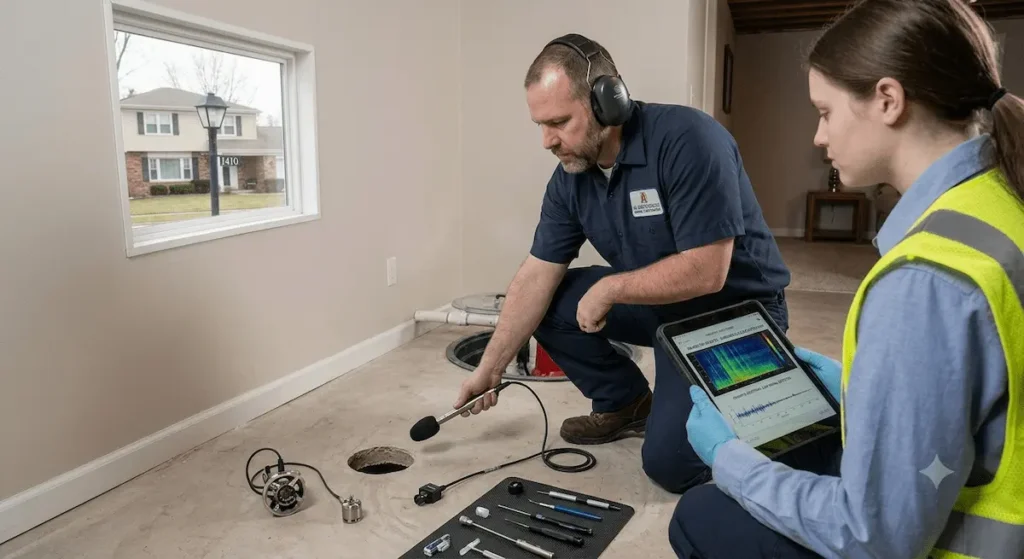
Professional leak detection Arlington Heights homeowners can actually trust means finding the failure before opening anything up. The most common locations are pinhole leaks in older copper pipe behind walls, slab leaks under concrete basement floors, fitting failures at the water heater or behind toilets, and underground water service line breaks between the meter and the foundation. The right technology depends on the location. Acoustic listening for pressurized leaks, thermal imaging for moisture spread, and hydrostatic pressure testing for confirmation. The honest contractor pinpoints the source first, then quotes the repair.
Six Signs You Have a Hidden Leak Right Now
Most leaks announce themselves long before the ceiling collapses. The patterns below are what your plumbing system uses to tell you something is wrong. Catching the leak at this stage costs a fraction of the restoration bill after a slow leak rots subfloor for six months.
Water Bill Jumped Without a Reason
An average four person home in this area uses roughly 6,000 to 9,000 gallons per month. A sudden 20 percent or higher jump in usage with no change in habits is one of the most reliable indicators of a hidden leak, often a slow drip running 24 hours a day.
Sound of Running Water With Nothing On
Stand in a quiet room with every fixture, ice maker, and appliance off. If you can hear water moving inside a wall or under the floor, something is leaking on the pressurized side. This is one of the most diagnostic symptoms there is.
Stains, Bubbling Paint, or Warped Drywall
Brown or yellow ceiling stains, paint that bubbles or flakes on a wall section, or drywall that feels soft to the touch all point to active moisture behind the surface. The leak source is usually higher than the visible stain because water travels along framing.
Musty Smell That Will Not Air Out
A persistent musty or damp odor in a basement, closet, or specific room is mold or mildew feeding on a moisture source you have not located yet. Air fresheners and dehumidifiers will not fix it, because the source water keeps replenishing.
Warm or Cold Spots on the Floor
A patch of basement slab or first floor that feels warmer than the rest is often a hot water slab leak. A cold spot can be a cold supply line leak. Both are signature symptoms of a leak under the concrete that needs targeted detection rather than guesswork.
Unexplained Wet Spot in the Yard
Lush, suspiciously green grass between the house and the street, or a patch of saturated ground in dry weather, almost always means the underground water service line is leaking. This is still your responsibility as a homeowner, even though it is underground.
The Two Hour Water Meter Test
Before calling anyone, run this simple test to confirm a leak actually exists somewhere in the system. It costs nothing, takes about two hours, and gives the technician useful information when they arrive. If the meter moves during the test window, you have a leak. If it does not, the cause is somewhere else.
Note the Meter Reading
Find the water meter inside the basement or in the front yard pit. Write down the current reading or take a clear photo. Note every digit including the small sweep hand if there is one.
Turn Off All Water Use
Shut off ice makers, the dishwasher, washing machine, and any humidifier tied to plumbing. Do not flush a toilet or run any tap for the next two hours. Tell everyone in the house.
Wait Two Hours
Leave the meter alone. Do not use any water in the home, indoors or outdoors. This window is long enough for even slow leaks to show movement at the meter.
Recheck the Meter
If the reading has changed even slightly, water is moving somewhere it should not be. That confirms a leak exists and the next step is professional detection to find where.
Three Technologies We Use to Pinpoint Leaks
Different leaks broadcast different signatures. Each of the three methods below finds something the others cannot, which is why a real diagnosis often uses our emergency plumbers, all three, to narrow the source to within inches before any drywall comes down.
Method 01
Acoustic Listening
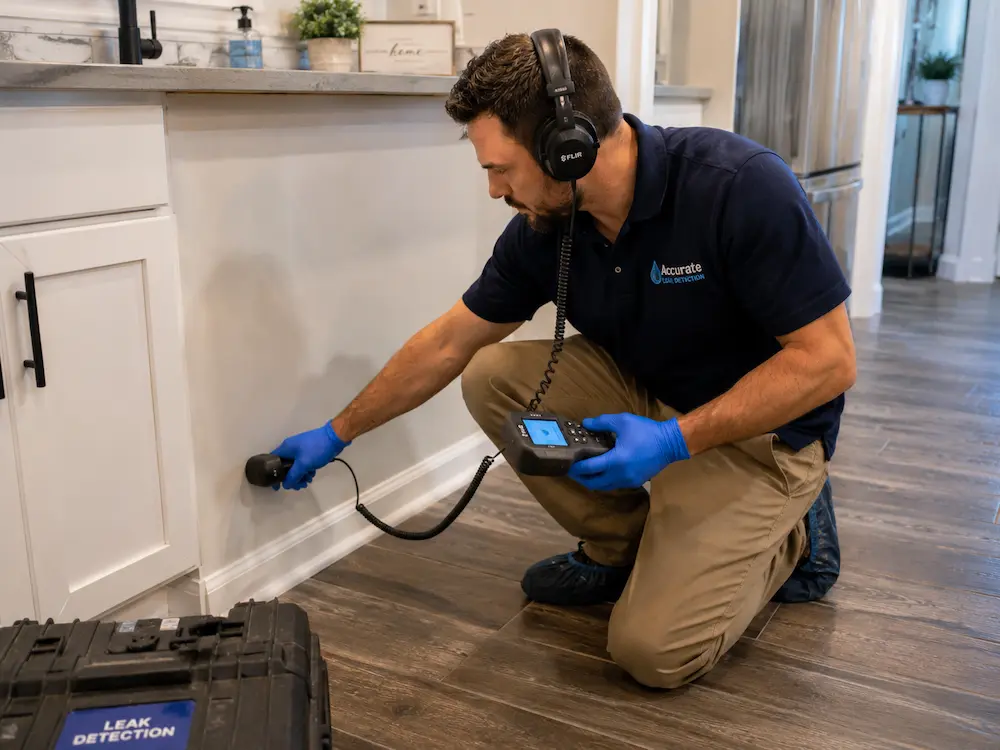
A sensitive microphone pressed against the wall, floor, or pipe picks up the high frequency hiss of water escaping under pressure. The leak makes a sound the human ear cannot hear unaided, but a calibrated acoustic device locates it down to a few inches behind drywall or under a slab.
- Finds pinhole and supply line leaks
- Works on copper, PEX, and galvanized
- Locates within a few inches
Best for: active, pressurized leaks in walls, ceilings, slabs, and the underground water service line between the meter and the house.
Method 02
Thermal Imaging
An infrared camera reads the surface temperature of walls, floors, and ceilings in real time. Moisture cools surfaces by evaporation, which shows up as a cooler patch on the screen. Hot water leaks show up as warmer patches. The image maps the actual extent of moisture, not just the leak point.
- Shows extent of moisture spread
- Documents damage for insurance
- Distinguishes hot vs. cold supply
Best for: mapping moisture behind drywall, finding the actual leak source higher than the visible stain, and producing images for insurance claims.
Method 03
Hydrostatic Pressure Testing
The plumbing system is pressurized and the pressure is monitored over time. A steady reading means the system is tight. A pressure drop confirms a leak exists. Combined with isolation valves at fixtures and supply zones, this method narrows down which branch of the system is failing before any wall is opened.
- Confirms leak exists, no guessing
- Isolates affected branch or zone
- Verifies repair after work is done
Best for: confirming a suspected leak, isolating the failing zone in a large system, and verifying the line is tight after the repair is complete.
Where Leaks Hide in Arlington Heights Homes
The location of the leak tells us a lot about the cause and the right method to find it. Here is what we typically encounter in the homes around the 60004 and 60005 zip codes.
Pinhole Leaks in Copper Pipe Behind Walls
Homes built between the 1950s and the early 1980s in this area commonly used Type M copper. After 40 to 60 years, electrochemical corrosion can perforate the pipe wall in tiny pinholes, often near elbows and dielectric union connections. Acoustic listening locates these precisely.
Slab Leaks Under Basement Concrete
Supply lines running under the basement slab can fail from corrosion, abrasion against the concrete, or settlement. Warm spots on the floor, unexplained moisture at slab edges, or a meter that moves with the main valve closed all point to a slab leak. Acoustic plus thermal narrows the spot before saw cutting.
Underground Water Service Line
The line running from the curb stop to the house foundation is the homeowner's responsibility, and breaks here cause wet patches in the yard, low pressure inside, and large unexplained water bills. Locating equipment plus acoustic listening on the exposed line at the meter finds the failure point without excavating the entire run.
Behind Tubs, Showers, and Toilets
The fittings, valves, and supply lines behind fixtures are common failure points. Wax ring failures under toilets cause slow leaks that rot subfloor invisibly. Shower valve cartridges weep behind tile walls. Thermal imaging often spots these long before the homeowner sees a stain.
Water Heater Connections and T and P Lines
Drips at the cold inlet, hot outlet, T and P relief valve, or expansion tank are easy to spot if you look. Most homeowners discover them only when the floor is already wet. Annual inspection at the water heater is one of the highest payoff plumbing checks there is.
In Ceilings From an Upstairs Bathroom
A first floor ceiling stain almost always traces to a fixture or fitting in the bathroom directly above. The visible stain is usually downstream from the actual leak because water runs along joists. Thermal mapping shows the real upstream source, which saves opening the ceiling in the wrong spot.
Smell Gas? Stop Reading and Get Outside Right Now
A natural gas leak is a life safety emergency, not a plumbing inconvenience. If you smell the sulfur or rotten egg odor anywhere in the home, do not flip a switch, do not light a flame, and do not run any electrical appliance. Get everyone outside immediately, then call 911 and your gas utility from outside the home. Once the building is cleared by the responders, that is when a licensed plumber locates the leak source with an electronic combustible gas detector and makes the repair.
- Leave the building
- Call 911 from outside
- No flames or switches
Why Older Arlington Heights Homes See More Hidden Leaks
The housing stock matters. A large share of homes inside the 60004 and 60005 zip codes were built between the late 1940s and the early 1980s, which means a lot of Type M copper supply lines have been quietly aging for half a century. Pinhole corrosion is statistically more common in homes from that era, and the hard water sourced from Lake Michigan accelerates wear on solder joints and dielectric unions at the water heater.
Layer in the dense glacial clay soil that holds moisture against foundation walls and underground service lines, and you have predictable patterns. The leak detection Arlington Heights homeowners actually need is one that knows what era the home is from and which failures are statistically most likely before the equipment comes out of the truck.
- Licensed by Illinois Department of Public Health
- Insurance grade documentation
- Acoustic, thermal, and pressure tools
- A local team, never a routing service
Five Things Not to Do Before the Plumber Arrives
A few well intentioned DIY moves actually make the clog worse and run up the bill. Here is what to skip while you wait.
1
Walk Through and Initial Assessment
We listen to your symptoms, review the meter test if you ran one, and walk the home noting visible stains, smells, and any soft floor areas before any equipment comes out.
2
Confirm With Pressure Testing
A hydrostatic test confirms a leak exists somewhere in the system and helps isolate which branch is failing. If the system holds pressure, the cause is something else and we say so honestly.
3
Pinpoint With Acoustic and Thermal
Once the affected zone is known, the combination of acoustic listening and thermal imaging narrows the failure to within a few inches. The technician marks the spot on the wall, floor, or slab.
4
Document and Quote Repair
You get a written report with thermal photos suitable for an insurance claim, a written repair quote, and a clear explanation of what the failure is and how it will be fixed. Then the work begins.
What Leak Detection Typically Costs Here
- These are honest typical ranges for the Arlington Heights area. Detection pricing depends on home size, leak location, and how many methods are needed to pinpoint, and repair quotes are always written up after the leak is located.
-
Standard Leak Detection Service Call $185 to $325
Acoustic and visual inspection
-
Comprehensive Detection With Thermal $325 to $585
Acoustic, thermal, and pressure
-
Hydrostatic Pressure Test $185 to $345
Whole system, with documentation
-
Slab Leak Locating $385 to $685
Acoustic + thermal under concrete
-
Underground Service Line Locating $425 to $750
Meter to foundation
-
Gas Leak Detection $245 to $485
Electronic combustible gas detector
-
Pinhole Leak Repair, Single Section $285 to $625
Copper pipe, accessible
-
Slab Leak Spot Repair $1,400 to $3,200
Saw cut, repair, patch back
-
Slab Leak Reroute $1,800 to $4,500
New line above slab to avoid future failure
-
Insurance Documentation Package Included
Photos, report, thermal images
-
Night, Weekend, Holiday Surcharge $0
Our policy
- A standard leak detection service call with acoustic and visual inspection typically runs 185 to 325 dollars. A comprehensive detection adding thermal imaging and pressure testing falls between 325 and 585 dollars. Slab leak locating runs 385 to 685 dollars and underground service line locating 425 to 750 dollars. Most repairs after detection follow a separate quote and depend entirely on the location, accessibility, and pipe type. Insurance documentation including thermal images is included on every detection visit at no extra charge, and there is no surcharge for nights, weekends, or holidays.
Neighborhoods and Towns We Serve
Leak detection service covers every Arlington Heights neighborhood including Scarsdale, Buffalo Grave, Hasbrook, Ivy Hill, Pioneer Park, and Stonegate, plus the surrounding Northwest Suburbs of Chicago listed below.
Arlington Heights 60004 & 60005
The same insurance grade documentation and transparent pricing applies across every neighborhood and town on this list.
Frequently Asked Questions
How can I tell if I have a leak before calling anyone?
Run the two hour water meter test. Note the reading on the meter, shut off every water using fixture and appliance in the house, wait two hours without using any water, and recheck the meter. If the reading changed, you have a leak somewhere. If it did not, your water bill spike or other symptom likely has a different cause. Either way, it gives the technician useful information.
Will you damage my walls to find the leak?
Detection itself is non invasive. Acoustic listening, thermal imaging, and pressure testing are all performed with the wall, drain cleaning, floor, or slab intact. We mark the precise spot of the failure on the surface so the repair, when it happens, opens the smallest possible area to reach the pipe. The whole point of professional detection is to avoid chopping drywall on a guess.
How long does leak detection take?
A typical residential leak detection visit takes one to two hours. Simple visible leaks may be located in under an hour. Slab leaks, complex multi zone systems, or underground service line failures can take two to four hours including pressure testing and isolating zones. You get a definitive answer in a single visit in the vast majority of cases.
Will my homeowners insurance cover the leak repair?
Most Illinois homeowners policies cover the water damage caused by a sudden and accidental leak but not the leak repair itself. A slow gradual leak often falls outside coverage entirely, which is why catching it early matters. Our detection report includes thermal images and a written summary suitable for filing a claim, which helps document the suddenness of the event and the extent of damage for the carrier.
What is a slab leak and is it serious?
A slab leak is a failure in a supply line that runs under the concrete basement floor or foundation slab. They are serious because the water has nowhere to go but sideways, eroding soil under the slab and potentially causing cracks or settlement over time. Warm spots on the floor, unexplained moisture along slab edges, and a moving meter with the main valve closed are the classic indicators. Targeted detection lets us repair through the smallest possible saw cut rather than chasing a guess.
Why do older Arlington Heights homes get pinhole leaks?
A lot of homes built between the 1950s and the early 1980s used Type M copper supply pipe, which is thinner walled than Type L. Combined with chloramine treated water, electrochemical reactions between dissimilar metals at fittings, and decades of small temperature and pressure cycles, the pipe wall can develop tiny perforations called pinholes. These leaks are slow but persistent and almost always require acoustic detection because they make almost no visible water until significant damage has occurred behind the wall.
Is the underground water service line my responsibility or the Village's?
In Arlington Heights, the water service line from the curb stop or the meter to the house foundation is the homeowner’s responsibility, including locating, repairing, or replacing the line. The Village maintains the main and the service connection up to the curb stop. A wet patch in the yard, a sudden pressure drop indoors, or a high water bill with no indoor cause are the most common signs of an underground service line leak.
Do you charge extra for nights, weekends, or holidays?
No. Leak detection service is available every day of the year with no after hours surcharge. The fair rate quoted on a Tuesday morning is the same rate on a Sunday evening or a holiday afternoon. Leaks do not wait for business hours and the pricing should not punish you for that.
Ready to Stop Guessing and Find the Leak?
Whether you have a ceiling stain, a 60 dollar water bill jump, the sound of water inside a wall, or a wet patch in the lawn, reach out for non invasive detection from a local crew with the right equipment. The leak detection Arlington Heights homeowners trust is one phone call away, with insurance grade documentation and a written repair quote after the source is found.